Leaderboard
728x15
Showing posts with label Brown Hare. Show all posts

Spring Hares

I thought I would do a quick post with some of the brown hares I photographed this spring as there is going to be a lot of birds coming in subsequent posts.  At least hopefully there will be, as in 4 days time I am off on my annual overseas adventure with the camera. This year I am spending 10 days in Iceland  where I will be travelling around with my good friend Steve in a camper van. I am not quite sure about how sensible the camping option is especially as Iceland has just had one of its coldest springs in many years. However, we wanted to stay flexible and not tied to any places or times especially as the sun will only be set for a relatively brief time. Of course I will be giving a full report of the trip here on my blog with a day by day account and hopefully with some interesting wildlife photos to show for our efforts.

Back to this blog post. The hares were a bit slow in getting started this spring with very low numbers present initially at one of my usual sites. One of the few hares that were around, I recognised from last year as she is particularly accommodating and use to my presence. As a photographer it always wonderful to have the opportunity of a wild animal taking you into its trust, allowing you to watch an observe a generally shy species from such a close distance.

It is always  a good feeling to get the first hare of the year in front of the camera. This one still in its thick winter coat, was taken in fairly low light as you can see from the size of the pupils.

I spent quite a bit of time with the 'friendly' hare, mainly getting low level photos. Small changes in elevation of the camera when close to the ground can make a big difference in the look of the resulting image as vegetation is blurred to different degrees. It is always good to have a subject that gives the time to experiment a little with the camera.
In the very early spring the hares seem to spend quite a bit of time in a small area of woodland from which they emerge at the beginning or end of the day to feed. The photograph below of one emerging from the woodland edge in the evening.

One of the reasons I love to photograph hares are they are so apparently full of 'character'. This one spent quite a while looking at me (I lost by blinking first in the staring contest) before getting down to the important job of giving the paws a clean. 
Numbers picked up as the weather warmed through into April, unusually  and much to my surprise I came across two well grown leverets. This was very early and presumably a reflection of some 'out of season' breeding during a relatively mild winter. Leverets are always a tricky target for the camera as not only are they very small and quick but they are also very unpredictable in their movements. Eventually one stopped for a couple of moments and allowed to me to get some images.
I will finish this post with one last photo of a running hare back-lit by the sinking sun taken during an evening session last month. I actually have the whole sequence captured as it ran right across in front of me at close range, but this was one of my favourites as their seemed to be good eye contact on the image.


Well I am 'just stepping out now and I maybe sometime' as I have a long list of jobs to get through before leaving for Iceland. This includes packing what is turning into a small mountain of gear and kit into two small bags. The next post will be about the Land of Volcanoes and Ice!

Just the Hare Necessities

Coming up to the end of the year is often the time to try and reduce the usual processing backlog and get the year's images wrapped up and finally backed up. So my first task was to go through some brown hare photos from the summer that have been left gathering dust on the hard drives.
I spent quite a bit of time with the hares again this year, an animal of which I can never tire. Its always such a pleasure being in their presence but I cannot quite put my finger on the attraction of hares for me. I mean I have obviously seen a large number of rabbits over the years but taken relatively few photographs but put a hare in front of me and the hours just seem to drift away. They certainly have mesmerizing glassy eyes that reflect that surrounding landscape.
Keeping those feet clean.
A warm summer evening spent lying down on the ground close to hare is such a wonderful experience and all of life's pressure and stress fade to nothing in the background. To use a versus from a song in the Jungle Book film but substituting bare with hare and you get the following which I think sums it up well.

'Look for the hare necessities
The simple hare necessities
Forget about your worries and your strife
I mean the hare necessities
That's why a hare can rest at ease
With just the hare necessities of life' 

May be I have just spent too long with hares !!

Anyway on to some photographs. The summer brown hare is a very relaxed animal they still breed throughout the summer with the occasional crazed boxing bouts but most of the time seems to be spent feeding and building up fat reserves to see them through the hard times in the coming winter months. This makes these shy cautious animals much easier to approach.

Hare's eyesight is geared up to detect movement. If you sit still enough they can sometimes walk right up to you, apparently completely oblivious to your presence. Some of you may remember a couple of years back when I told you of a hare that walked up to me whilst sat in a hedgerow and started licking my boot, presumably for some residual salt left on it from a beach wader photography session.
If you need to approach them then crawling flat is the way to go as they, together with many animals, associate the upright human form with danger. At times you will be surprised how close you can get to a hare. The tricky part is often leaving without disturbing it as crawling very slowly backwards with a heavy camera is not the easiest movement to make. However, the goal with all wildlife photography should be not to disturb or stress your subject. I see many people having got their photos then forgetting about their subject, standing up and sending whatever they were photographing speeding off to the horizon.  My view is you should back away as carefully as you approached.
With the brown hares now quiet my thoughts are rapidly turning to photographing mountain hares given that they will be well in to taking on their white winter coats. It is all dependent on the weather which is never to be taken lightly in their habitat.

Leverets

During this summer I have spent a fair amount of my time photographing Little Owls which will be the subject of a couple of future blog posts. The owls were resident in an old farm building which had a gravel track running down its side which separated it from a field with a potato crop. As Little Owls are most active during dawn and dusk and it was inevitable that during these sessions I would also encounter some other birds and animals which show a preference for these times of day.
Whilst sitting waiting for owls I would see the occasional brown hare coming down the track and cutting across the grass verge and into the potato plants.
During July three leverets appeared briefly for a couple of weeks and not only gave some good opportunities for photography, which does not happen to often,  but were also a great deal of fun to watch. Leverets always seem slightly comic in appearance with their ears and feet which they always seem to need to grow into. They also always seem slightly uncoordinated in their movements as if someone above is pulling strings attached to the legs in the opposite direction to that which they want to go. These mini hares are also highly unpredictable, sitting still one moment and then bouncing around all over the place the next as if they are receiving repeated electric shocks.

They are actually fairly difficult to photograph given the apparent randomness of their movements, u combines with their small size and impressive speed.  Sometimes they have the appearance of a turbo-charged guinea pig. The world must seem a very large place to a small leveret.
It was interesting to watch the three of them interacting and most of their time was spent chasing each other in circles among the potato plants. Important 'playtime' training to avoid future predation. There was another interesting moment when one approached a rabbit and seemed to be trying to provoke it into a chase although the rabbit was having none of it.

My brief moments with these leverets was very enjoyable especially when combined with the Little Owls and provide a useful and entertaining distraction whilst waiting for the owls to appear. I hope these hares are all still around and fairing well as this declining species is currently afforded no statutory protection in the UK. In my view this is one of our most enigmatic small mammal species and deserves a higher legal conservation status to ensure that future generations can enjoy the spectacle of the 'mad' March hares running around the fields.

7 Year Itch

It dawned on me the other day that I have now been photographing brown hares through every season for the last 7 years. I can't imagine what the cumulative number of hours I have spent within them over that period in which I have witnessed many memorable moments. The whole spectrum of hare behaviour has been before me at one time or another that has included boxing, rolling around on the floor like a dog, standing upright like a meerkat, flattening themselves against the ground to hide, running washing, shaking, jumping in the air, the list goes on and on. There have been young hares and old, females and males in all conditions with rain, wind, sun, hail, frost and snow. Despite all this, I keep finding drawn back to them again and again. For some reason a fascination with hares get under your skin and causes  an itch that you can never quite fully scratch and relieve.
This spring I seem to have spent quite a bit of time photographing the hares and have particularly been concentrating on taking low level photographs to give a hare's eye view on their world. This is obviously not the easiest of photography as it requires getting your self into a position where your lying on the ground just a few metres away. The 7 years of experience with reading hare reactions obviously helps overcome some of these challenges but it was also aided by finding one particularly accommodating hare that seemed to be appearing in the same spot in the evenings.  I have found that hares quite often do this and certain individuals can be quite habitual in nature. This hare seemed fairly oblivious and very relaxed in my presence. Being in very close to a hare like this is one of life's great pleasures.

Taking photographs at ground level when the vegetation is quite short, apart from giving you neck ache!,  is an interesting exercise. What I was aiming to achieve was the hare in amongst an out of focus green mush of vegetation, so there are no distracting elements. In reality what you find that small changes in ground height, and your position and particularly the height of the camera can make major differences to the resulting photograph. At this close to a hare, particularly adjusting your position have to be done very slowly and quietly whilst watching the hare at all times and gauging its reaction.


When your in close to a hare its amber coloured glassy eyes reflect the surrounding environment, in the case below the evening sky, but I am always curious as to the thought processes that are going on behind.

The images in the post are a selection from a series of short evening sessions that I have spent with the hares over the last few weeks.

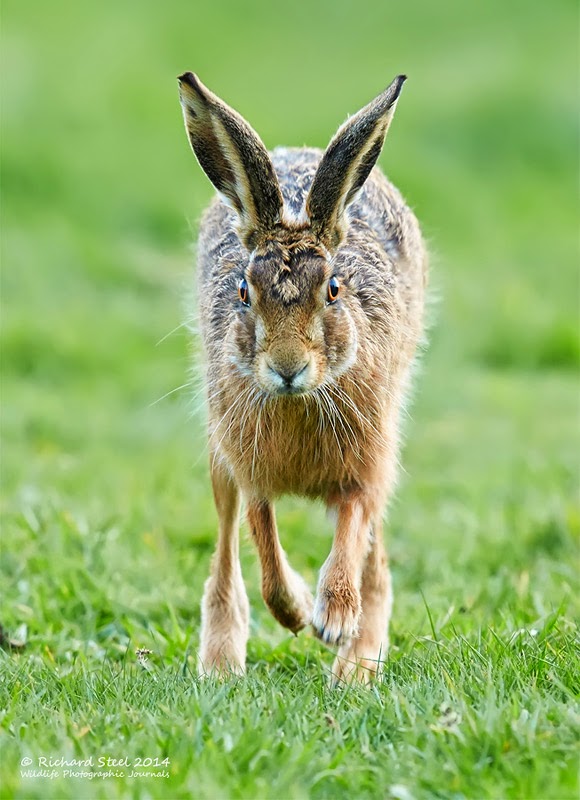
An incoming hare. When they are running straight at you it requires a steady hand to hold focus as they get large and larger in the frame.
 Those large ears swivel round in all directions constantly alert for danger.
So the hare itch continues and has now in fact grown worse having located some of the mountain variety last winter. In another 7 years I will hopefully still be here as will the hares discussing the 14 year itch.

Relaxed Spring Hares

Springtime is synonymous with brown hares as they are very visible in the low field crops, as they chase each other around with the males all vying for the attention of the female. At the site I visit they can be quite unpredictable in the spring. On some days it will be like a 'hare desert' whilst on others they seem to be everywhere. I think the main driver for this is when a female on heat is around as you often see numerous male running around and constantly stopping to sniff the ground trying to locate their target.

Most of the hare 'madness' seems to take place in the morning with them being a good deal calmer in the evening as they have a feed before nightfall. The words 'relaxed' and 'spring hares' are not often seen together but its all about time of day. So for portraits the evenings at the moment are often a better proposition.

My patient better half often questions why I spend so much time photographing 'those rabbits'. Apart from being completely different to 'rabbits', anyone who has spent time with hares will know the answer. Simply they are  fascinating animals, that are a pleasure to spend time with. This fascinating aspect is a feature that has not just captured my attention but the imaginations of many over centuries which is why the hare has become steeped in so much myth and folklore.

A couple of weekend back I headed out on a short evening session. Always good to have some wildlife photography that doesn't require a ridiculously early alarm call.  As is typical with the rapidly changing spring weather the sunlight and clear skies when I left home had turned to overcast conditions by the time I had arrived. I was a bit early as most of the hare activity would take place as the light was starting to fade and for the first hour of so I only managed to find one hare grazing on some fresh spring grass. There was a patch of daffodils behind and I waited until the hare slowly ate its way forward and the flowers provide some colour in the background. Spring encapsulated in a single image, well sort of ;).

As the session progressed, the light started to diminish, I started finding more and more hares. All of them were just sitting quietly, busily eating or just having a good stretch. Below are a selection of images. You can tell that the light had gone low by the size of the hares' pupils. The superb high ISO performance of the 1DX keeps you shooting when other camera have long gone to bed.

I was just finishing with a low level photo of a hare peeking over some long grass and thought it was about time to head home.
When I turned around there were two hares behind me but the female looked slightly odd in the fading light as it was striking pale in comparison to the darker  attendant male.
In fact I have never seen such a fair coloured hare in all my years of photographing them. On arriving home I did a Google search and found that sometimes they can appear pale during the transitional moult between winter and summer coat. Whatever, the reason it was a striking beautiful animal which certainly provide a great finale to the session.
Leaderboard