Leaderboard
728x15
Showing posts with label Corn Bunting. Show all posts

Exploring Extremadura: Day 3 am - Azure Wings

The phone alarm vibrated into life on the side cabinet beside the bed to announce the start of another day in Spain. It was still dark outside, as I rolled out of the bed into my clothes and downstairs to the bar for a quick coffee before we departed to our hide for the morning. This morning's session was to concentrate on Azure-winged Magpies. Regular readers will know I am a big corvid fan and was looking forward to seeing some of these birds having only previously seen them in my local zoo.

The weather was not looking typically 'Spanish' with thick grey clouds above with the occasional light shower but it appeared likely that the clouds would break during our session and let some light through. It was around a twenty minute drive to the magpie site and which ended in the usual long winding farm track into a lovely looking area of rough grassland interspersed with clumps of mature trees.

It looked like we would be in for another cramped hide session given the size of the hide, which was also fitted at the front with glass to photograph through. I am not a big fan of glass fronted hides but I understand why hide operators use them. To get the best quality images requires the lens hood to be removed and the front of the lens placed as close and square to the glass as possible. It also seems to help if the lens aperture is stopped down a little rather than using a wide open lens.

In front of the hide there was a large table structure which had a lined shallow pool of water on top, a grassed area at the back and a number of perches strategically placed around it. Before our hosts left some peanuts were scattered strategically around the drinking pool and perches. We did not have long to wait before the first birds arrived, in the shape of Spotless Starlings, although the light was still fairly low with the dense cloud cover above.

These birds have a very glossy feathers with an attractive iridescent sheen and almost look like they have been dipped in oil.
They were also being very vocal and had a wide repertoire of calls and songs that included mimicking some other birds.
Behind the pool and perches we could see a pair of Woodchat Shrike and the female paid a brief visit to one of the perches.
The first of the Azure Winged Magpies started to arrive. The light was still poor so the most of the early images ended up getting deleted. These are such beautiful birds and easy to see where they got their name. This species of magpies appeared slightly smaller and milder in manner than the European Magpie than I am accustomed to.
The clouds above were starting to break letting some soft warm early morning light through as the numbers of magpies arriving increased.
 At one point the magpies all disappeared for some unknown reasons resulting in some the appearance of some other species. Such as Spotless Starling and a Corn Bunting in 'key jangling' song.
A cuckoo was also moving around and perched on a branch above the water pool but we frustratingly could not take photographs of the bird due to the confines of the cramped hide and problems with shooting up through the glass at an angle. Whatever had put the magpies off from visiting had obviously now passed and they soon started to return once more. This gave plenty of opportunities for some additional photographs of the birds.
I suppose my main disappointment was the hide didn't really offer any good opportunities for any flight images, particularly with the glass. I was looking forward to getting some flight images having spent hours photographing the European magpie in flight.

All too soon the familiar rattle of a the car engine was approaching and the session was over. It was time to return to the hotel, find some lunch, sort out the camera gear and morning's images and hopefully fit in a a quick siesta before leaving for the evening hide session.

Roaming in Romania - Day 7: 'Groundhog Day'

Everyone was outside the ' 'roach motel' early the next morning, obviously very keen to get away from the place. With the luggage and camera bags loaded back into the minibus, we headed off back to the the drinking pool hide and farmland tracks. Rene and I returned back to the hide for the morning session while Hans and Michael toured the dusty farmland tracks to see what they could find.

The drinking pool hide was extremely quiet and we spent most of the morning watching a solitary frog lazily swimming around and snatching the occasional fly trapped in the surface film. Eventually a Turtle Dove arrived for a quick drink before departing leaving the pool eerily quiet once more.

It was coming close to collection time so we decided to give up on the hide and see if we could stalk some birds on foot. A cuckoo was flying around, chasing another bird so we started with that and managed to get a couple of photographs before it disappeared in pursuit into the distance.
There was not much else around except the occasional singing Corn Bunting. After much crawling through the undergrowth I eventually managed to get up close to a bird.

At this point I had a chat with Rene whether it was really worth staying here for the afternoon or if we should suggest moving on to our next destination, subject to the agreement of the other two photographers. In the distance a cloud of approaching dust signalled the return of the minibus. A quick exchange on how the morning session had gone and it was a unanimous decision that we should leave Macin behind and head to our final destination the coastal lagoon areas near Constanta on the Black Sea coast. After lunch at the lay-by restaurant once more we hit the road again and headed east on a journey of a couple of hours along the bumpy roads of Romania.

Our first destination was some tracks running through an extensive area of farmland. This was within the Cogoleac Wind Farm which is an enormous area dotted with over 240 huge wind turbines,  gently turning in the breeze, that have invaded the landscape in all direction,

Our drive round the farmland tracks was fairly unproductive, although not surprising given that there were four of us in the minibus. It was particularly frustrating from my position in the back corner of the minibus which made it extremely difficult to get the camera on the bird and only then if it was on the right hand side. A funny thing I have noticed on this trip and subsequent ones is that the places people first select in a vehicle or hide, and in this case also the boat, is the same one they stick to for the entire duration of the trip. It obviously pays to think about this carefully at the start of a trip which I obviously hadn't on this occasion. In our drive around the tracks I only managed to take photographs from my restricted position of a male Ortolan Bunting and a new species, the sturdy Calandra Lark, perched on top of sunflowers. I am sure the other photographers will have got some photos of other species as well.
We left the farm tracks but not the wind farm to finish the day off at the low limestone valley at Cheia. This was a beautiful spot but somewhat spoilt by the accumulations of litter left by visitors. The sky was clouding up quickly and the light was in decline.

The main target species here were Pied Wheatear and the European Ground Squirrel or Souslik which inhabit the sheep grazed carpet of grass on the valley floor. The Pied Wheatear were very striking birds but fairly unapproachable with little cover. After several attempts I managed to get a couple of photographs of both the female and the very beautiful male. In hindsight I wished I had spent a bit more time trying to get some better photographs of these wheatear.

The female
and the male.
However, my attentions were drawn to the Souslik that could be seen dashing across the grass before disappearing down a burrow only to emerge somewhere else. In a similar way to Marmots (Groundhog) or Meerkats, there would often be one animal on sentry duty that would let out a very loud high pitch warning squeak when people approached. I decided the best approach was to lie down where I had seen one disappear down a burrow and hope it appeared back out of the same hole of from where nearby where I could crawl up to it to get closer. This waiting tactic seemed to work well. It was good fun photographing the ground squirrels and time passed quickly when I noticed the rest of the group waiting by the minibus to depart.

A head emerges from the labyrinth of tunnels below.
I think this may be an older ground squirrel as it had very pale colouring and appear right next me so I could only just fit it in frame
.
On sentry duty

and calling which is very loud when you are right next to it!

We headed off to the check-in to our hotel in Sinhoe. A very nice hotel indeed and a complete contrast to where we had stayed the previous night. Our first destination for the next day, our final full day in Romania, was to be to try and photograph some Collared Pratincole a bird that has long been on my 'wish list'.

Roaming in Romania - Day 6: The Macin Mountains

Another very early alarm call pushed me out of the bed. It was quite strange to hear the sound of occasional traffic outside rather than a chorus of frogs.  After a brief bit of stumbling around my room to gather my belongings I headed down to the hotel reception, where I had chance to grab a quick coffee before boarding the minibus with the other three photographers. Our destination today was the Macin Mountains. After about an hour we turned off the main road and headed up a dusty dirt track across a patchwork of flat farmland to finally come to a stop at the lower slopes of the mountains.
Our plan for the next two day was that we would split into two groups with two sessions in a drinking pool hide, the only fixed hide of the whole holiday, and two sessions going round the farm tracks seeing what birds we could find. Hans and Michael took the first hide session while Rene and I headed off in the minibus with Zoltan.

As we travelled down the dirt track away from the hide, the occasional Corn Bunting could be seen flitting between song perches and Isabelline Wheatear dashed on to the track to grab an insect. I noted there were a few puddles on the track from recent rainfall. The first bird we managed to put in front of the lens was a Short-toed lark quietly calling from a large boulder in the early sunlight.

We carried on along the dust track for a while before we heard the ubiquitous cuckoo call and decided to stop for a while as Rene was keen to get some photos of the three birds that were preoccupied  chasing each other around.

By the time we had finished with the cuckoos the sun was well and skyward with the light becoming increasing harsh. However, more importantly and has been my experience of photographing on farmland previously, a heat  and water vapour haze was very quickly developing. Heat haze is a major cause of people thinking  their camera has malfunctioned as the wobbling air can make it very difficult to produce sharp images. This was well demonstrated as we came across a perched European Roller but the images all went in the trash. There are only two approaches for these conditions which are to pack up or to get very close to the birds to reduce the amount of wobbling air between you and them. Even if you can get very close there is still a need to take a lot of images as a good proportion of them will not be sharp.

The next bird which we managed to get very close to was the familiar sight of a Goldfinch which was busy pulling apart a globe thistle seed head.

Onwards down the track and we came to a small section  that was relatively busy with birds including Tawny Pipit and a new species for me, the Crested Lark. The latter is very similar in an appearance to a Skylark but with a permanently erect head crest.
Conditions were getting more and more difficult and after a failed attempt to find an Ortolan Bunting we finished the session with a close encounter with a singing Corn Bunting
.

The dry dusty farmland with its assortment of sandy coloured birds was a stark contrast to the lush vibrancy of the Delta that we had recently left. We returned to the hide to collect Michael and Hans who reported a very slow morning with only a Turtle Dove and out of condition Hawfinch showing up. The drinking pool hide at Macin can be very productive particularly during prolonged hot and dry conditions. However, the puddles on the tracks were a sign of recent rainfall providing the birds with other places to find essential water.

We all headed off into Macin to check in to another hotel where we would fortunately only be staying for one night. To say the hotel was very grim is an understatement. My door lock was hanging on by a single screw having obviously been forced open on several occasions. Certainly somewhere to sleep on top of the bed covers with your boots on to prevent being eaten alive by the mattress wildlife and also allow a quick exit if needed. Everyone quickly decided it was not the place to leave any camera equipment which would now stay with us for the rest of the time in Macin.

We had a pasta lunch outside of a roadside restaurant before heading back to the farmland and hide. Rene and I were dropped off for our afternoon session. For those of you not familiar with a drinking pool hide it is basically an infinity pool for birds with a hide at one end. The design of the pool tends to force the birds to visit the far end and the low set hide allows photography near water level.

As we sat and waited in what felt like a mini-sauna, there were sounds around would have been a delight to any bird lover's ears. In the tree behind the incessant calling of cuckoo and gentle purring of Turtle Dove, to the left the metallic jangle of a Corn Bunting, in the large distant tree ahead the flute-like calls of Golden Oriole and in the bush to the right the scratchy warbles of a Red-backed Shrike. In front of us to photograph....nothing. Eventually a bird appeared in the shape of a male Ortolan Bunting, a promising start. The attractive bunting stayed for a while on a small perch before deciding it was safe to bathe.

Another hour past with no signs of birds except the occasional flash of a male Golden Oriole chasing away a cuckoo. The next arrival was a Corn Bunting which paused briefly before getting down to the important business of cleaning its feather.

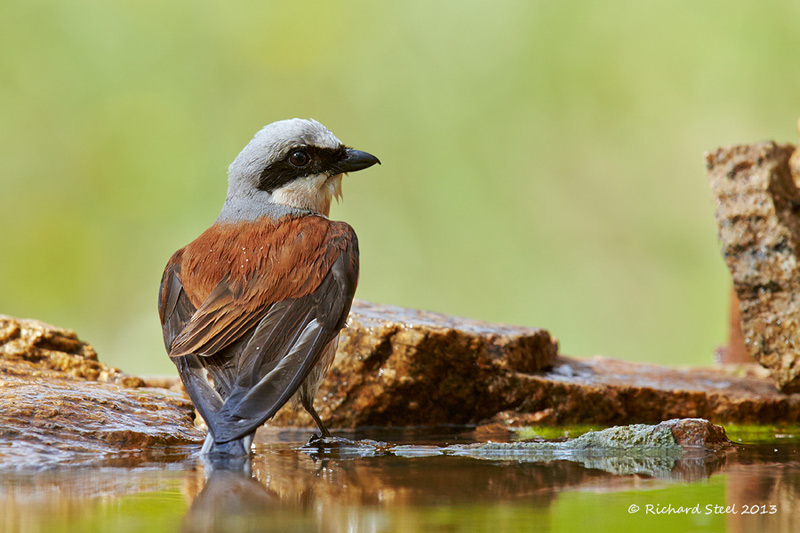
After the bird departed we were forced into a prolonged wait once more. We sat there hoping that a Golden Oriole might come in to bathe but it never happened. The arrival of the next bird did jolt us from our late afternoon lull, a stunning male Red-backed Shrike which has been there the whole afternoon just out of sight in the bush to our right. For me this was definitely bird of the day.

A Jay was the next visitor. When these birds decided to get a bath they don't mess around and soon the bird was completely soaked.

The final bird to arrive was a Turtle Dove. These are such beautiful birds but under so much pressure across Europe from intensive farming and hunting pressures. In the UK, this once common bird, is very sadly rapidly heading towards extinction as a breeding species. Efforts are being made to try and help the species in the UK but I wonder if the external pressures are too great and it is too little and too late to save this attractive dove.
That was the last bird which visited and we soon heard the rattle of the white minibus returning to collect us. Overall it had been a reasonable day but fairly slow, particularly in the hide where long periods of inactivity were punctuated by the occasional bird. We went straight for a meal before heading back to the 'roach motel'  where I quickly fell asleep on top of the bed still wearing my boots.
Leaderboard