Leaderboard
728x15
Showing posts with label Fieldfare. Show all posts

Winter Fieldfare

The winter influx of Fieldfare from the north seemed to be late this winter.  I checked the usual sites in November and the rowans were laden with berries but empty of birds. However, they did eventually arrive in big numbers providing some photography fun during December. These birds are one of my favourite thrushes, such smart and attractive looking birds and typically show quite a bit of variation in the intensity of their colour and markings.

Photographing birds feeding in trees on berries requires some patience to get the birds in a good setting otherwise you end up with images of birds in a 'jungle' of sticks.


My usual approach is to look carefully at the tree and trying to select the end of branches or the lower branches where a bird can be photographed against a clean background. Whilst waiting I always concentrate on particular branches hoping the birds will land there. Sometimes they do, often they don't. The ideal point to visit a rowan tree is when the birds have reduced the berries down to the lower branches, as they tend to eat their way down from the top, which generally provides some better opportunities and also the chance for some more interesting backgrounds. A couple of examples of this are shown below. Having found an interesting background these two photographs show a bird on the same branch, the first with a bird closer to the tree trunk and second photograph was taken by waiting for one to land on the end of the branch.


Another example, in my view the first has a few too many distracting elements in the image whereas the second is more the type of image I hope to photograph.


Of course this is not always possible, and so when the sky forms the background it is important to choose a day of good weather, which can be infrequent in the winter, to provide a blue sky for the backdrop. In my view a bird in a rowan in dull light against a white sky is a non-starter and on these days its time to look for birds on the ground.  Fortunately in December we have had a couple of periods of high pressure providing  good conditions for photographing the birds and of course such days are accompanied by that wonderful golden soft low winter light.

A further advantage of the ends of branches or those hanging down from the tree is that they also provide some more interesting photos as the they are thin and unstable and usually requires some balancing by the bird to stay on them. The four images below are from a rowan where the remaining berries were on long thin branches hanging down. The birds needing to use their tails and wings to balance.


The constant mantra while photographing the birds is setting and background....setting and background....  and small changes in position can make a big difference to the resulting photographs.

After the birds have been on the rowans for a few days you tend to start finding them on the ground below feeding on fallen berries.

However, Fieldfare are relatively shy birds and so remain always alert and wary.

When not feeding on the berries they will start hunting worms and as with all thrushes show the characteristic slow moment across the grass listening for the worms below.

I will finish off this post with a day I went out and the sky wasn't really suitable for photographing birds in the trees so I was looking for birds on the ground. Eating berries tends to make the birds thirsty and so they will often visit puddles to drink and bathe. I managed to find a group using a long puddle in the middle of a quiet cul-de-sac and immediately spotted an opportunity for some images.


Interestingly after the birds left the puddle, I went to look at it from the other side and found it would have created images with dark water and been back-lit which could have produced some interesting photographs. Maybe something for another day.

Frosty Fieldfare

Firstly I would like to wish all the readers of this blog a very Happy New Year and hope you have some memorable wildlife encounters during the coming 12 months. I am looking forward to many exciting photography projects ahead and already have a trip planned to Iceland for the end of May. I hope you will all join me on my photographic journey this year.

Apologies for the lack of blog updates over Christmas, which is always a busy time, but I have also been trying to make the most of the Christmas break to get some time out with the camera when the weather has allowed. It has actually been quite a productive time for my photography and I will start with a morning session on the 28th December after a very sharp overnight frost.

I set off early from the house to a local site that I have visited for many years now to see if I could find some more Fieldfare. After some snowfall on Boxing Day, which melted very quickly around my home by the coast, I thought there may be a chance that there may still be some on the ground further inland. On arrival it was obvious that this was not the case but the hard frost could provide some interesting photographs. The large noisy Fieldfare flock had long since stripped the Rowan trees of berries but there were still others that were conspicuously heavily laden with berry crop. These were Sea Buckthorn and Cotoneaster. These really are at the bottom of the bird berry menu and usually need several hard frosts to make them palatable to the birds. Sea Buckthorn in particular always seems to be a last resort food choice and the bright orange berries only seem to be eaten when conditions are particularly tough for the birds which the ground frozen for an extended period which stops them finding worms.

I decided to do a bit of reconnaissance to see what the birds were doing before settling on my approach for the morning. As it was still first light the majority of the main Fieldfare flock were only just waking and sat in the tops of the trees fluffed up to insulate them from the cold. They started moving and it became quickly obvious that they were targeting  Cotoneaster. Unfortunately the trees they were heading in to were in a very awkward position in terms of light direction. However, I remembered there were some other Cotoneaster further down the road which may provide a better opportunity and arrived to find a single Fieldfare actively guarding each tree.
I have seen Mistle Thrush do this before but not Fieldfare. Every bird that arrived at the tree would be quickly chased off. These trees were heavily-laden with berries and although the action was going to be slow decided to sit it out as I could see there would be some potentially good photographs to be had with a bit of patience.

While waiting for the Fieldfare to move in to good feeding positions a Robin kept me amused as did a very large brown rat that kept scuttling around under the tree.
Whilst sat there I noticed there was a small number of Fieldfare flying in to frost covered bush about 50m down the road. So I decided on a quick relocation to them before the sun pushed too far round. The low soft winter sun has a lovely quality to it and was just illuminating the birds on the dark frost covered bushes.
Occasionally a bird would drop to the frozen grass below.

I decided it was time to return to the Cotoneaster as visible steam started to rise off the bush in front of me as the sun hit the frosty leaves. This usually plays havoc with the camera focus and achieving sharp images can be very difficult. Every 30 minutes or so one of the birds in each of the trees would move to eat a few more berries. It was just a question of waiting for them to appear in the right place. The action was slow but it proved to be a very enjoyable and relaxed morning in some beautiful sparkling winter weather.

Here are some photographs from the Cotoneaster bush and from the ground below it.

I decided my my next Christmas sessions I would try and get some of my favourite waterfowl the sawbill ducks but these will have to wait until my next post.

Feathered 'Selection Box'

Christmas is upon us once more. I am sure the years grow shorter as I get older as it seems like only a blink of an eye since the last.  I thought it was time for a seasonal selection box. However, this one is not filled with sticky spiced chocolates but some recent images of the local bird life. Typically the winter weather has not been particularly kind recently and in fact at times it has been bordering on very grim with frequent strong winds, plenty of rain and dark blankets of grey clouds above. As such, light, the essential element for photography, has been in relatively short supply. So it has been a question of being at the ready with camera and snatching odd moments when the light and free time have put in a combined appearance.

I have also been working on a small unexpected winter bird photography project which I will reveal in a future post. The delay in posting is mainly to protect these birds from unwanted attention and potential disturbance.

So lets not waste any more time and dip into the avian selection box. I will start off with a scarce bird for this area, the Long-tailed Duck. I asked a good friend of mine if he wouldn't mind looking in on a lake local to his home whilst passing, to see if there were any Goldeneye present. There were none but he sent a picture text to my mobile and said he had seen an unusual duck but was not sure what it was. I immediately recognised it as a Long-tail duck and more interestingly it did not seem to have been reported anywhere. Unfortunately not one of the stunning drakes but it was too good an opportunity to pass by, a scarce bird that the crowds of bird watchers and photographers had yet to discover. A quick visit was in order. I found the bird easily as it seemed to be staying away from the other birds up one end of the small lake and managed to get close by the old 'move when it is underwater' routine. After a few photographs it was slowly making its way along this small lake when I noticed a patch of reflected reeds that were turning a patch of water golden and this was the result.

The shortest photography session ever was recorded when I decided on a bit of flight practice with some Black-headed Gulls on the local marine lake. Despite a large patch of clear winter blue sky above, the low sun stubbornly refused to lift from behind the only bank of cloud except for about 2 minutes. This was the best I could muster on this icy, blustery day in 120 seconds.
We are still on the first layer of the selection box and this time a brief sunny morning session looking for some winter thrushes. In the distance I saw two birds feeding on a grassed area and assumed that these were my target. However, as I got closer I could see one was a blackbird and the other looked slightly odd, only revealing itself properly as I approached to be a Green Woodpecker, as it  flew up to a nearby tree. After a short while waiting and predicting where the bird might appear, I got the opportunity for about 2 seconds to get a couple of photographs of this beautiful shy female bird before it was gone.
The winter thrushes I was seeking I typically only found a flock  about 10 minutes before I had to leave. The Fieldfare has to rate as probably our most attractive visiting winter Thrush species. This one showing showing a typical drooped wing pose.
The flock was accompanied by a single Mistle Thrush that was also picking out fallen rowan berries from a gravel area. The birds having already completely stripped the tree above its fruit.
Let's dip in to the layer below of the selection box and see what lurks there. Ahh...seems to be a wading birds.

The first was taken on the way home after a wholly unsuccessful session with the small winter project I mentioned earlier. As I swung into the 'home straight' which takes me along the coast I noticed it was high tide and decided to check one of the regular roost for wading birds. They are not always there and I thought may be absent that morning as it was a fairly large tide but was pleasantly surprised to find around 50 Redshank, and a similar number of Turnstone perched high on the rocks. However, what really drew my attention were three Purple Sandpipers and so concentrated on those.
My next encounter with some waders was on a day when I decided to head out for some Red Breasted Merganser on the local marine lake. I like to photograph swimming birds on either very calm surface or the dynamic conditions of rough water. The forecast was for strong westerly winds but it turned out to be blowing much harder and much colder than expected. The marine lake resembled the North Sea in a storm and so there was little chance of seeing, let alone photographing the Mergansers. However, the first light visit coincided with a rising tide which would see the wader flocks coming into roost. A good number of Redshank, Turnstone and a few Dunlin and a solitary Knot had gathered.
I took a few photos and noticed spray being blown into the birds from the crashing waves driven by the punishing wind which created an interesting effect backlit in the first light of the day. I thinks this photographs gives a great impression of the harsh weather we were all enduring that morning.

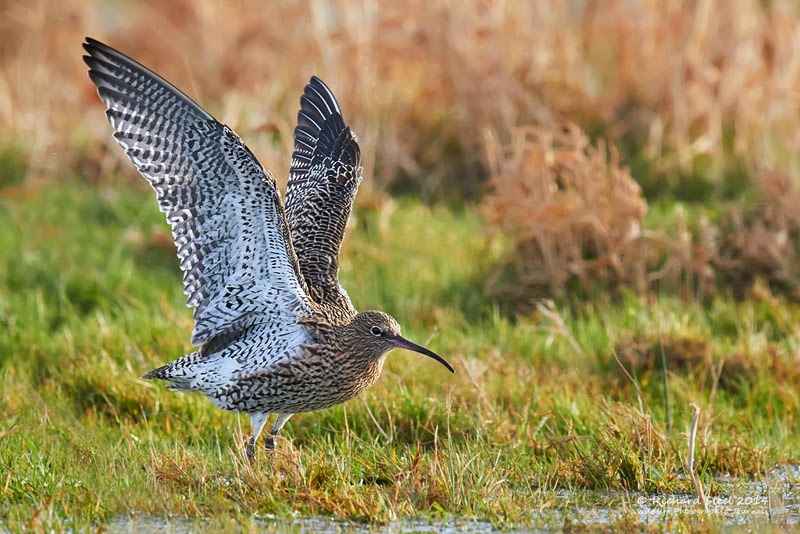
After I while I decided it would be good to head home and get my hands round a warm coffee, leaving the tough wading birds to sit it out. I took a route home that would see me pass an area that curlew often use at high tide when the sand banks are covered with water. I have always liked curlew. They may not be the most colourful birds but are beautifully patterned and surely possess one of the most evocative bird calls. The birds were across the road from their usual area and seemed to be getting disturbed by the Sunday morning dog walkers. Fortunately one dog walker pushed the birds right over to where I was waiting.
With that the bird selection box is now empty. For those of you interested, all of the above with the exception of the Purple Sandpiper were taken with a Canon 7d Mk2.

So I would like to take this moment to wish you all a Very Merry, Healthy and Peaceful Christmas with a suitably tacky e-card.

Fieldfare and Festive Greetings

I have never been able to decide if I prefer Fieldfare or Redwing out of the two winter visiting thrushes. The arrival of Fieldfare, when you see the large loose flocks overhead with their distinctive chattering flight calls,  is always a sign to me that winter is fast approaching,  The birds typically arrive from Scandinavia around October and quickly descend upon trees with berries with rowan  being a particular favourite.

They are a large smart looking thrush with their combination of brown back, grey head and black-spotted amber breast. When you spend quite a bit of time with these birds you notice there is quite a bit of variation in patterning with the darker coloured birds tending to be the most striking in photographs.

The unusual weather this year of a  prolonged cold spring and a warm summer seemed to provide very good conditions for berry growth and by the early autumn the trees were heavily laden and ready for the winter thrush invasion. Given the glut of berries available it took a while for the birds to arrive at the site which I usually visit to photograph them. However, when they did arrive it was en mass with a big flock of around 500 birds.

Fieldfare are quite a wary species and  the site I visit is made slight  frustrating as there is a long row of Rowan trees which the birds favour although this can only be accessed from one side. The trees never really get the low winter sun on them properly, and the majority of the day they are back lit with a bit of side lighting in the late afternoon. If only the landscape architect who designed the planting scheme had put them the other side of the road, it would have made the task for the photographer so much easier. However, the trees do attract good numbers of birds and it is just a question of looking for other nearby opportunities for  for photographing them.

Eating berries makes the birds thirsty and by positioning myself next to a puddle  provided some opportunities to capture some images of the birds drinking.
 I must have moved the lens a little too quickly as both birds stopped drinking and look straight towards me.
I found one puddle which had some reflected autumn hues on the water from the fallen leaves on the bank behind and where one particular bird decided it would bathe.


Of course as with any bird photography you often get a bonus or two along with your target species. During this session it was a striking male Bullfinch which was also taking advantage of the free berry feast.
As this is Christmas eve, I was also take the opportunity to wish you all a very Merry Christmas and a happy, healthy, successful and wildlife-filled New Year.


Leaderboard